
Stablecoin supply nears $270 billion
The total stablecoin market capitalization has stabilized near the $270 billion mark, a level that reflects a structural shift in market participation. As of mid-January 2026, the aggregate supply hovered between $269 billion and $270 billion, indicating that the rapid expansion phase has given way to a mature, institutional-driven equilibrium. This plateau is not driven by retail speculation but by the increasing integration of stablecoins into traditional finance infrastructure.
Tether (USDT) continues to dominate this landscape, maintaining its position as the primary vehicle for liquidity and settlement. The stability of this supply suggests that market participants are treating stablecoins as a reliable store of value and medium of exchange rather than a speculative asset. This behavior aligns with broader trends in institutional adoption, where regulatory clarity and operational reliability are prioritized over yield-chasing.
The concentration of supply among a few major issuers underscores the importance of reserve transparency and compliance. As regulatory frameworks tighten, the market is consolidating around entities that can demonstrate robust audit trails and adherence to legal standards. This consolidation is likely to continue, reinforcing the dominance of established players like Tether while limiting the entry of new, unvetted competitors.
The current market structure suggests that stablecoins are becoming a foundational layer of digital liquidity. Their role in facilitating cross-border payments, tokenized asset settlement, and decentralized finance operations is expanding, even as the overall supply remains relatively flat. This dynamic indicates a shift from growth-at-all-costs to stability and utility, a trend that will likely define the next phase of the crypto market.
USDC versus USDT volume trends
The stablecoin market in 2026 is defined by a bifurcation between trading liquidity and institutional settlement. Tether (USDT) retains dominance in raw transaction volume, serving as the primary medium for crypto-to-crypto exchanges and global peer-to-peer transfers. Conversely, USD Coin (USDC) has solidified its position as the preferred instrument for regulated financial flows, driven by stricter compliance frameworks and partnerships with traditional payment rails.
The divergence in usage patterns reflects distinct regulatory environments. USDT’s market cap and daily volume remain highest, particularly in emerging markets and high-frequency trading venues where speed and broad exchange support outweigh compliance scrutiny. USDC, backed by Circle and subject to regular attestation reports, is increasingly integrated into institutional custody solutions and enterprise payment systems. This shift aligns with the emerging regulatory focus on "permitted stablecoin issuers" as outlined in recent digital asset outlooks from major financial institutions.
| Feature | USDT | USDC |
|---|---|---|
| Market Cap | Largest (~$110B+) | Second Largest (~$40B+) |
| Primary Use Case | Crypto trading, P2P transfers | Institutional settlement, payments |
| Regulatory Compliance | Mixed, offshore focus | High, US-regulated attestation |
| Institutional Adoption | Moderate | High, enterprise integrations |
For legal and compliance professionals, the distinction is critical. USDT’s dominance in volume does not equate to institutional preference. The rise of USDC in regulated flows signals a maturation of the market, where transparency and legal clarity are becoming primary drivers of adoption over mere liquidity depth. As regulatory frameworks solidify, the gap between these two assets is likely to widen in terms of use case specialization rather than direct competition.
RWA tokenization drives institutional demand
Real-world asset (RWA) tokenization is establishing a structural demand for stablecoins as the primary settlement rail for tokenized treasuries and bonds. This shift moves digital assets from speculative trading into the core infrastructure of institutional finance, where reliability and regulatory compliance are paramount.
The emergence of clear regulatory frameworks in 2026 has accelerated this transition. According to Deutsche Bank’s Outlook for digital assets 2026, new regulations legally create “permitted stablecoin issuers” for the first time. This designation provides the legal certainty required for large-scale institutional participation, transforming stablecoins from experimental tools into recognized financial instruments.
Stablecoins facilitate the efficient transfer of tokenized debt instruments, reducing settlement times and counterparty risk. As global stablecoin rules reshape payments, the demand for US debt assets is intensifying, with tokenized treasuries offering a liquid, programmable alternative to traditional holdings. This integration is pressuring other jurisdictions, such as the UK, to finalize their own frameworks to remain competitive.
The convergence of RWA tokenization and stablecoin utility creates a robust ecosystem for institutional liquidity. By anchoring digital value to real-world assets, the market is moving toward a more transparent and efficient financial infrastructure, driven by observed flows rather than speculative trends.
Cross-border payments see faster settlement
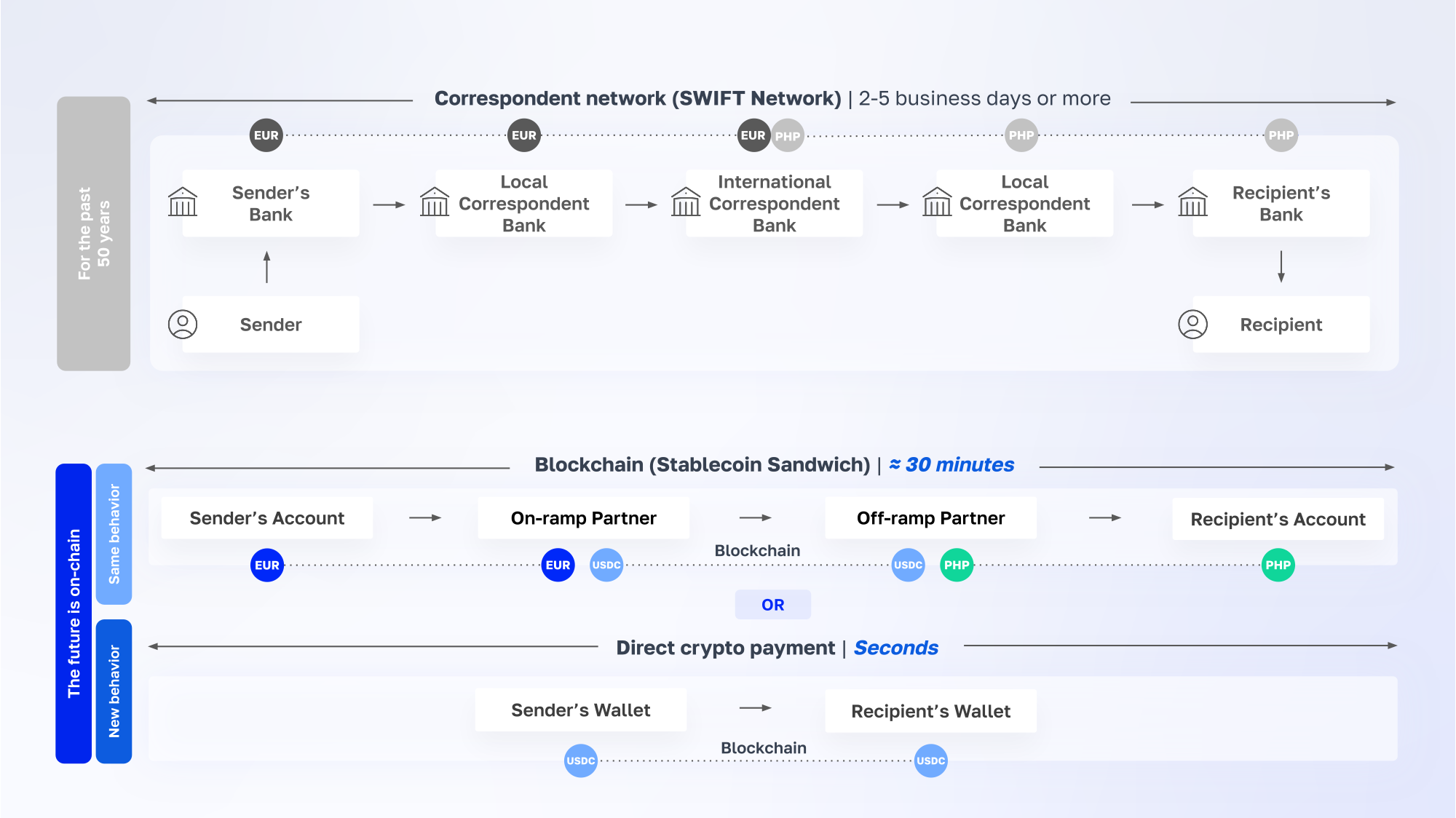
Stablecoins are displacing traditional correspondent banking for cross-border transactions by offering immediate finality and reduced intermediary friction. Unlike legacy wire transfers that rely on a chain of correspondent banks, stablecoin settlements occur on distributed ledgers, allowing funds to move directly between origin and destination. This structural shift addresses the latency inherent in the SWIFT network, where multi-day settlement periods tie up capital and increase operational risk for financial institutions.
The scale of this transition is evident in recent market data. According to OpenFX’s Q1 2026 report, stablecoin transaction volume reached $27.6 trillion, underscoring the asset class’s capacity to handle high-volume, high-value liquidity movements across borders. This volume reflects a growing institutional preference for stablecoins as a primary settlement layer, particularly for regions with fragmented banking infrastructure or limited access to traditional foreign exchange liquidity.
Regulatory scrutiny has intensified alongside this adoption. Legal frameworks in major jurisdictions are increasingly focusing on the compliance obligations of stablecoin issuers and the anti-money laundering (AML) protocols required for cross-border flows. Institutions must navigate these evolving regulations to ensure that their use of stablecoins for international payments remains compliant with both local and international standards. The trend indicates a maturation of the market, where speed and efficiency are balanced against rigorous regulatory adherence.
Regulatory frameworks shape 2026 flows
The 2026 stablecoin landscape is defined by the implementation of comprehensive global regulatory frameworks. These rules, led by the US, EU, and UK, are no longer theoretical proposals but enforced standards that dictate how digital assets interact with traditional finance. The primary outcome is the forced standardization of compliance protocols, which directly reduces counterparty risk for institutional participants.
In the United States, the implementation of strict reserve requirements and regular attestation mandates has created a clear distinction between compliant and non-compliant stablecoins. Institutions are migrating capital toward issuers who meet these rigorous standards, effectively treating regulatory adherence as a baseline for liquidity access. This shift has stabilized the market, reducing the volatility associated with unbacked or loosely regulated tokens.
The European Union’s Markets in Crypto-Assets (MiCA) regulation has set a precedent for cross-border harmonization. By establishing a unified licensing regime, MiCA allows stablecoin issuers to operate across member states without navigating fragmented national laws. This clarity has encouraged European banks to integrate stablecoin settlement rails into their existing infrastructure, viewing the regulatory certainty as a prerequisite for scaling digital asset operations.
Meanwhile, the United Kingdom is finalizing its own framework, aiming to position itself as a competitive hub for digital asset innovation while maintaining high consumer protection standards. The convergence of these major jurisdictions is creating a de facto global standard. For institutional investors, this regulatory convergence simplifies due diligence and reduces the legal overhead of managing multi-jurisdictional stablecoin portfolios, thereby accelerating the adoption of real-world asset tokenization.
No comments yet. Be the first to share your thoughts!