
Map your jurisdictional requirements
Cross-border stablecoin payments rarely stay within a single legal boundary. A transaction might originate in the United States, clear through a European settlement network, and settle in an Asian merchant account. Each leg of that journey triggers different regulatory frameworks. To navigate 2026 stablecoin regulations effectively, you must first identify which laws apply to each specific flow.
Start by mapping the issuance jurisdiction. In the United States, the GENIUS Act establishes the baseline for permitted payment stablecoin issuers. Under this framework, issuers must maintain reserves backing outstanding stablecoins on a one-to-one basis. These reserves are strictly limited to specific assets, such as US dollars, federal reserve notes, or funds held at insured depository institutions. If your stablecoin is issued by a US entity, these reserve requirements dictate your operational constraints regardless of where the user is located.
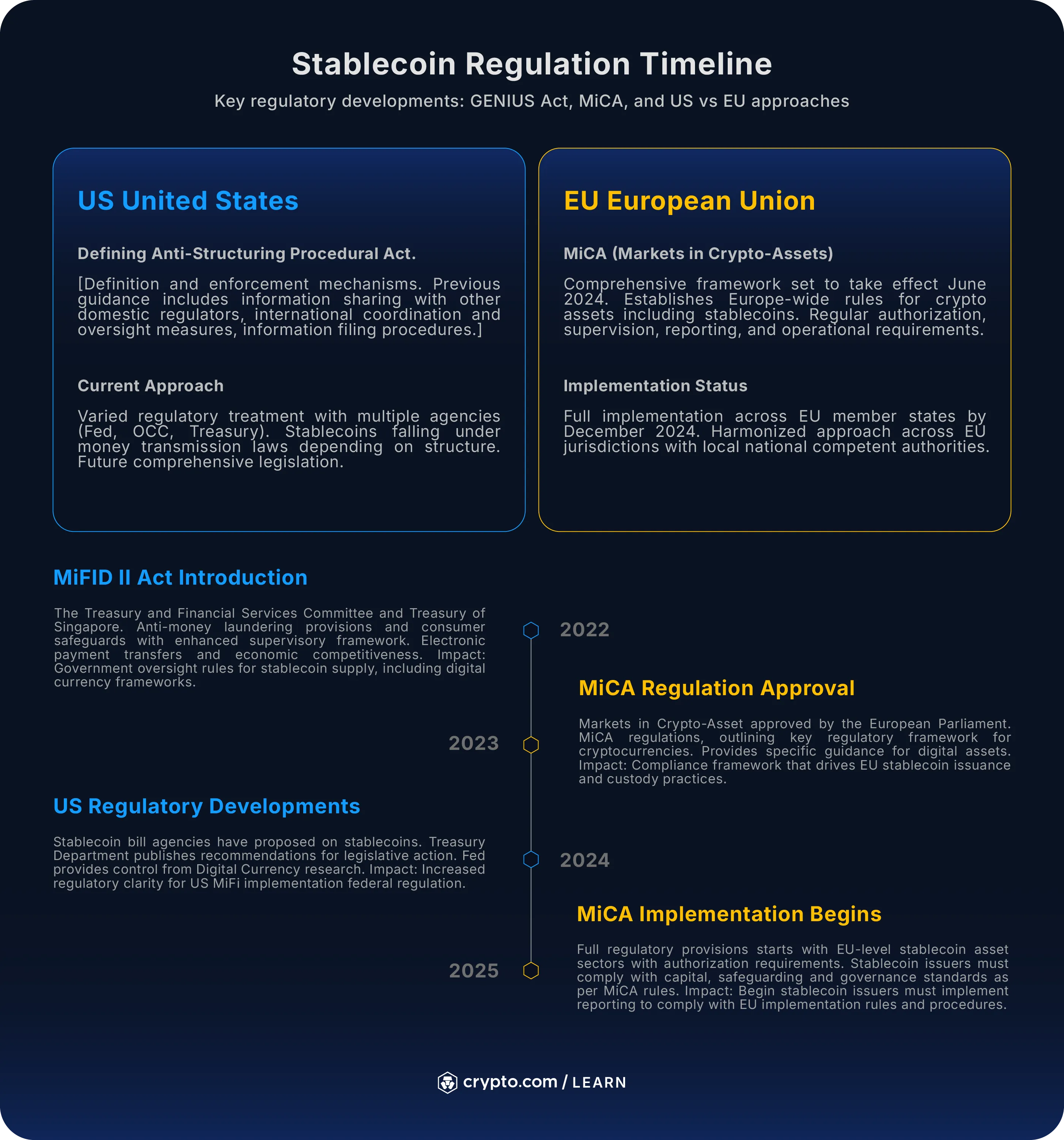
Next, determine the settlement jurisdiction. If your transaction settles in the European Union, the Markets in Crypto-Assets Regulation (MiCA) applies. MiCA imposes its own licensing, reserve, and consumer protection standards on asset-referenced tokens and e-money tokens. A US issuer settling funds in the EU may find itself subject to dual oversight, requiring compliance with both the Federal Reserve’s proposed rules and EU financial authorities.
Warning: Issuing a stablecoin in the US but settling in the EU creates a dual-regulation risk. You must satisfy the reserve requirements of the GENIUS Act while simultaneously meeting MiCA’s distinct liquidity and disclosure mandates. Failure to align these frameworks can result in operational freezes or regulatory penalties in either jurisdiction.
Finally, verify the user’s location. Many jurisdictions apply their laws based on where the end-user resides, not where the transaction originates. If your platform serves users in multiple countries, you need a jurisdictional map that links each user segment to its specific compliance obligations. This map should include licensing status, reserve rules, and reporting requirements for every relevant market.
Use the Federal Register and official EU publications as your primary sources for these requirements. Relying on third-party summaries can lead to gaps in your compliance strategy, especially as implementing rules continue to evolve throughout 2026.
Verify reserve asset eligibility
Before launching any cross-border payment flow, you must confirm that the underlying reserve assets meet the strict liquidity and safety standards mandated by 2026 stablecoin regulations. The GENIUS Act, enacted in July 2025, establishes the federal framework for this compliance. Issuers are required to maintain reserves backing outstanding payment stablecoins on at least a one-to-one basis. These reserves cannot consist of arbitrary crypto assets; they must be high-quality, liquid instruments.
Check US Treasury and Federal Reserve eligibility
Under the GENIUS Act, permissible reserve assets are limited to specific low-risk instruments. You must verify that your stablecoin’s reserve pool consists primarily of:
- US Treasury Bills: Short-term government debt obligations with maturities of one year or less.
- Federal Reserve Notes: Physical US currency held in secure custody.
- Bank Deposits: Funds held at insured depository institutions or certain regulated banks, subject to specific caps.
The US Treasury has proposed rules to implement these requirements, emphasizing that reserve assets must be segregated and readily convertible to fiat for redemptions. This ensures that even in a market stress scenario, users can redeem their stablecoins at par value without delay. The OCC’s 2026 bulletin further clarifies that issuers must demonstrate continuous compliance with these asset composition rules through regular audits.
Compare international reserve standards
If your stablecoin operates across borders, you must also satisfy local regulatory requirements. The EU’s MiCA regulation, for instance, imposes distinct reserve asset rules for Electronic Money Tokens (EMTs) and Asset-Referenced Tokens (ARTs). While both frameworks prioritize safety, MiCA allows a broader range of short-term money market instruments and bank deposits, provided they are diversified and not concentrated in a single institution.
| Feature | US GENIUS Act (Proposed) | EU MiCA |
|---|---|---|
| Primary Asset | US Treasury Bills | Cash equivalents, short-term debt |
| Custody | Segregated, audited | Segregated from issuer assets |
| Redemption | One-to-one, immediate | One-to-one, same day |
| Concentration | Strict caps on bank deposits | Diversification required |
Audit and document compliance
Verification is not a one-time event. You must implement ongoing monitoring to ensure reserve assets remain eligible. This includes:
- Real-time monitoring: Track the maturity and credit quality of Treasury bills and bank deposits daily.
- Quarterly attestation: Obtain independent attestations from qualified auditors confirming reserve sufficiency.
- Regulatory reporting: Submit required reports to the Federal Reserve and OCC (or relevant EU authorities) detailing reserve composition.
Failure to maintain eligible reserves can result in severe penalties, including license revocation. Ensure your compliance infrastructure can automatically flag any asset that falls below the required liquidity or safety thresholds.
Structure redemption and settlement flows
Cross-border stablecoin payments rely on trust. If your system cannot convert tokens back to fiat quickly and transparently, the transaction fails. The GENIUS Act mandates that permitted payment stablecoin issuers (PPSIs) redeem stablecoins within two business days. This deadline applies to all redemption requests, regardless of where the user is located.
To meet this requirement, you must build settlement flows that prioritize speed and auditability. A redemption is not just a blockchain transaction; it is a legal obligation to return value. Your operational workflow needs to handle the request, verify the reserve backing, and execute the fiat transfer in a way that regulators can trace.
Follow these steps to structure a compliant redemption and settlement process.
Before moving any funds, confirm the request is legitimate. Under the Bank Secrecy Act (BSA) and Anti-Money Laundering (AML) rules, issuers must verify the identity of the redeemer. This step prevents fraud and ensures you are sending fiat to the correct account. Integrate this verification into your user interface so the user knows exactly what documents or data are needed to proceed.
The GENIUS Act requires reserves to back outstanding stablecoins on at least a one-to-one basis. When a redemption request arrives, your system must instantly verify that the requested amount is fully backed by eligible assets, such as US dollars or federal reserve notes. If reserves are insufficient, the redemption must be paused or partially fulfilled. This check protects the issuer from insolvency and ensures the stablecoin remains pegged.
Once verified, initiate the fiat transfer to the user’s designated bank account. The FDIC’s proposed rule emphasizes the two-business-day window. Use established banking rails or correspondent networks that can reliably settle within this timeframe. For cross-border payments, factor in time zone differences and local banking holidays. If a transfer cannot be completed within the window, you must notify the user and document the delay.

Every step of the redemption must be logged. Create an immutable record that links the blockchain transaction hash to the fiat transfer confirmation. This audit trail is critical for regulators who may review your compliance with the GENIUS Act. Ensure your logs include timestamps, reserve verification results, and the final settlement status. This transparency builds trust with both users and oversight bodies.
By following this sequence, you ensure that your cross-border stablecoin operations remain compliant and efficient. The key is to treat redemption not as an afterthought, but as the core mechanism that validates your entire payment system.
Audit compliance and reporting
Cross-border stablecoin issuers must establish regular audit cycles and reporting mechanisms to demonstrate adherence to 2026 stablecoin regulations. This section outlines the task sequence for setting up these systems.
1. Define the audit scope
Identify which reserve assets require verification. The GENIUS Act requires permitted payment stablecoin issuers to maintain reserves backing outstanding payment stablecoins on at least a one-to-one basis. Determine which assets fall under this requirement, such as US dollars or federal reserve notes.
2. Select an auditor
Choose a licensed and supervised entity to conduct the audit. Only licensed and supervised entities can process and issue stablecoins under new global regulations. Ensure the auditor has experience with cross-border payment systems.
3. Schedule the audit
Set a regular cycle for audits. Quarterly audits are recommended to ensure continuous compliance. This helps identify any discrepancies early and allows for timely corrections.
4. Conduct the audit
The auditor will verify the reserve assets. This involves checking the balance of reserves against the outstanding stablecoins. Ensure all assets are held in accordance with the proposed rule requirements from the Federal Register.
5. Report the findings
Prepare a detailed report of the audit findings. This report should be shared with regulators and users. Transparency is key to maintaining trust and compliance.
6. Address discrepancies
If any discrepancies are found, take immediate action to correct them. This may involve adjusting reserves or updating internal processes. Document all corrective actions taken.
7. Update internal processes
Use the audit findings to improve internal compliance processes. This helps ensure future audits are smoother and more efficient. Regularly review and update policies to reflect any changes in regulations.
-
Verify reserve assets are held in approved accounts
-
Ensure auditor is licensed and supervised
-
Schedule quarterly audits
-
Prepare detailed audit reports for regulators and users
-
Address any discrepancies immediately
-
Update internal compliance processes based on audit findings
By following this task sequence, issuers can establish robust audit and reporting mechanisms that meet the requirements of 2026 stablecoin regulations. This not only ensures compliance but also builds trust with users and regulators.
No comments yet. Be the first to share your thoughts!