
Stablecoin flows 2026
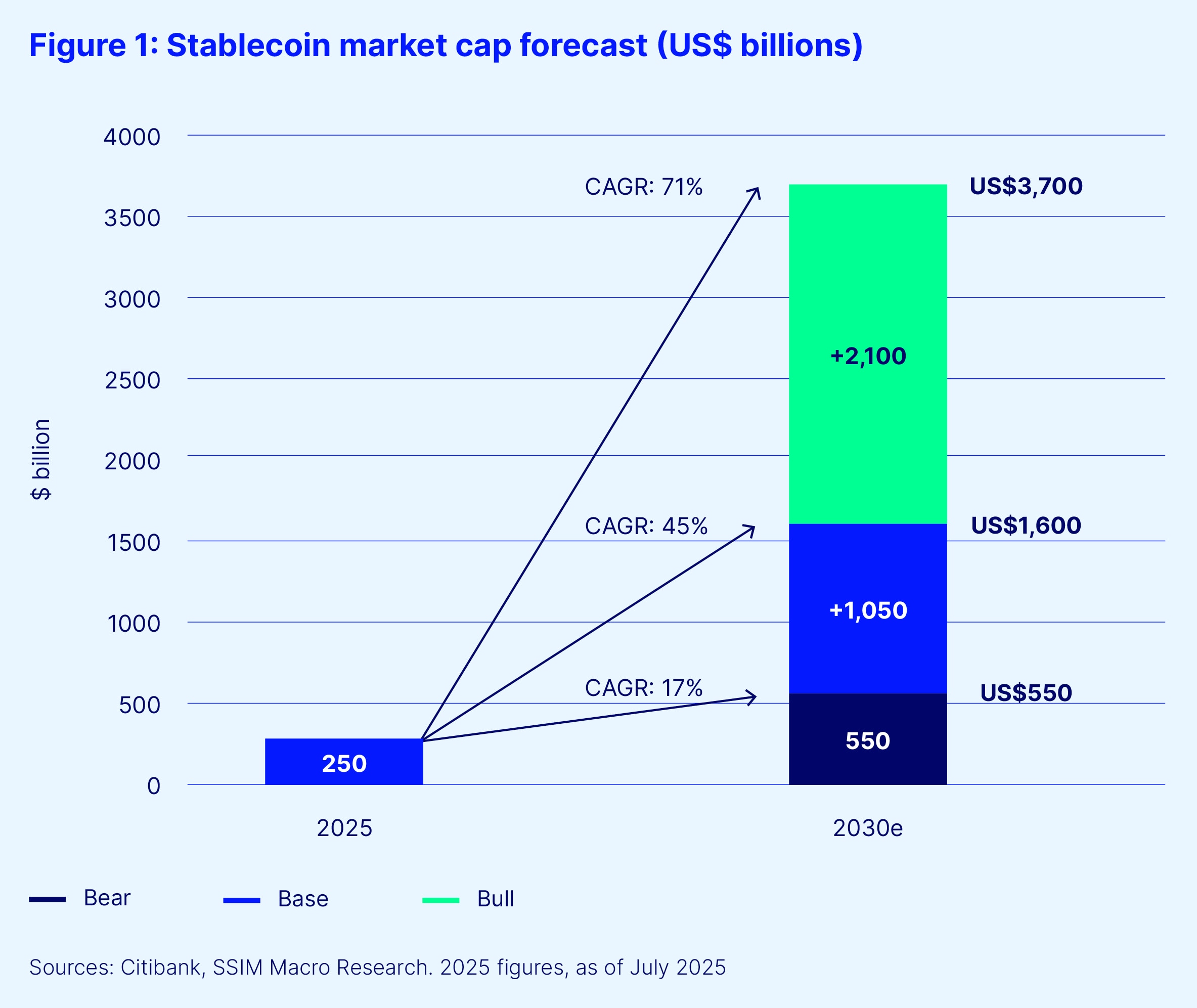
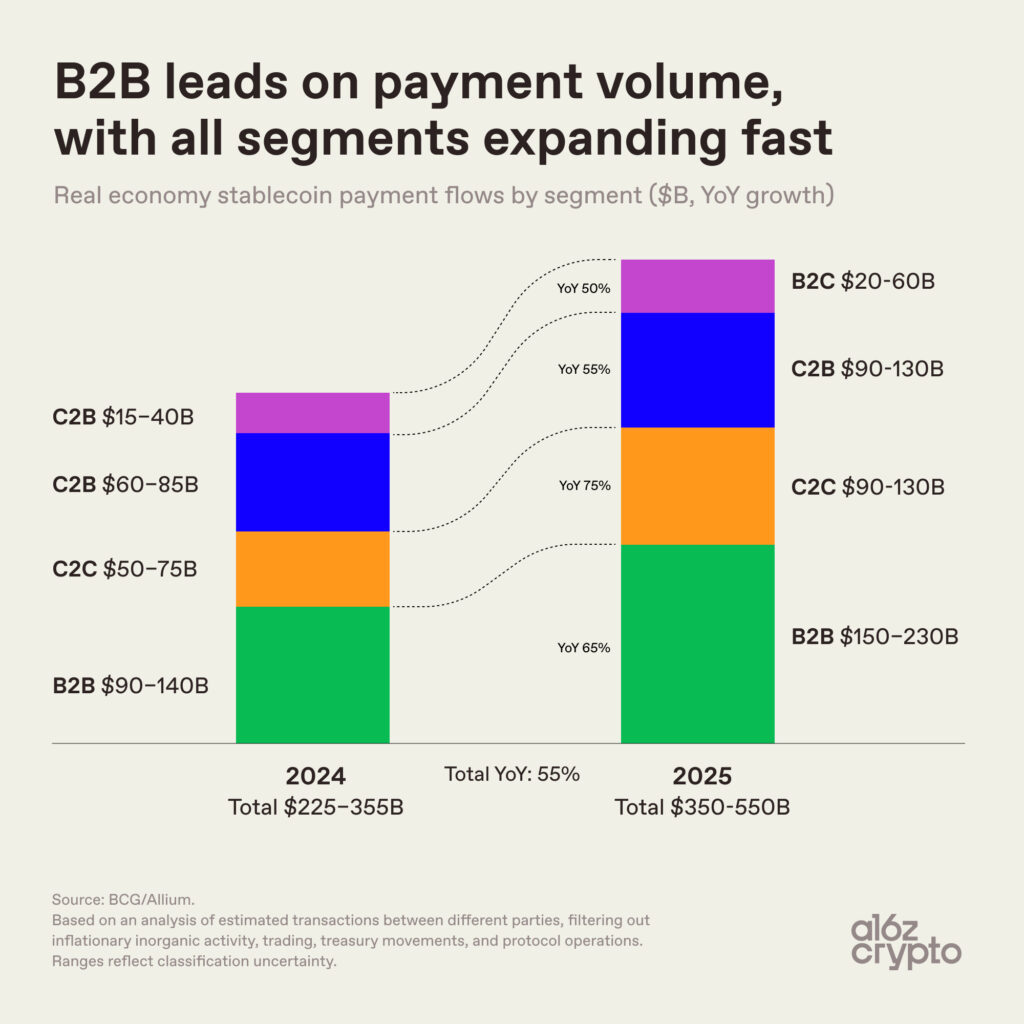
The stablecoin market reached approximately $313 billion in mid-2026, marking a 23% year-over-year increase. While the total addressable market for cross-border payments exceeds $17.9 trillion, the actual volume moving through these rails tells a more nuanced story. In 2025, stablecoins processed between $28 trillion and $62 trillion in transactions. However, only about $350 billion to $550 billion of that volume represented real-economy payments. The vast majority of activity consisted of trading, arbitrage, and moving funds between exchanges and wallets rather than settling commercial invoices or consumer purchases.
This distinction matters for institutional capital inflows. Real-world asset tokenization is driving genuine liquidity into the ecosystem, but the primary use case remains financial infrastructure rather than everyday commerce. Tether (USDT) remains the largest issuer by global volume, with reserves comprising cash, cash equivalents, and other short-term assets. Understanding where this capital actually flows—whether for speculative trading or tangible asset settlement—is critical for assessing the long-term viability of stablecoin integration in traditional finance.
Stablecoin flow tradeoffs in 2026
Stablecoins have grown into a $313 billion market, yet they still represent just 1% of global payment flows. This gap between market capitalization and actual usage defines the core tradeoff for institutional capital: volume does not equal velocity. In 2026, the distinction between trading capital and real-economy settlement has become the primary filter for evaluating stablecoin utility.
| Metric | Trading Volume | Real Payments | RWA Yield |
|---|---|---|---|
| Primary Driver | Arbitrage & leverage | Cross-border speed | Yield & compliance |
| Capital Efficiency | High (circular flows) | Moderate | Low (long lock-ups) |
| Regulatory Risk | Low (private use) | High (Aml/KYC) | High (securitization) |
| 2026 Growth | Stabilizing | Accelerating | Explosive |
The most critical factor to evaluate is the nature of the inflow. Trading volume accounts for the vast majority of stablecoin movement, but it is often circular—funds moving between exchanges and wallets without entering the real economy. Real payments, which totaled only $350–550 billion in 2025, represent the true test of infrastructure resilience. Institutions must distinguish between liquidity that stays within the crypto ecosystem and capital that settles external obligations.
Real-world asset (RWA) tokenization introduces a different set of tradeoffs. While it drives significant capital inflows by bridging traditional finance with blockchain, it requires strict compliance and longer settlement windows. The yield generated by RWAs is attractive, but the regulatory overhead is substantial. In contrast, cross-border payments offer speed and lower costs but face higher scrutiny from anti-money laundering frameworks.
For institutions, the decision hinges on the intended use case. If the goal is yield generation, RWAs are the primary vehicle. If the goal is operational efficiency, cross-border payments are the standard. Trading volume remains a liquidity indicator but offers little direct utility for traditional business operations. Understanding these distinctions is essential for navigating the 2026 stablecoin landscape.
How to Choose a Stablecoin Strategy for 2026
Stablecoin adoption has bifurcated. The market is now roughly $313 billion, up 23% year-over-year, but the use cases have split sharply between speculative trading and real-economy payments. Only about $350–550 billion of the $28–62 trillion moved in 2025 was actual cross-border settlement; the rest was wallet-to-wallet trading volume [src-serp-2].
To deploy capital effectively, you must align your stablecoin choice with your primary operational goal: speed, compliance, or yield. The following framework evaluates the tradeoffs between the dominant dollar-pegged assets for institutional use.
For institutional treasury operations and cross-border settlements, regulatory clarity is the primary filter. The total addressable market for stablecoin payments exceeds $17.9 trillion, but only assets with transparent, audited reserves and clear legal standing should be used for business-critical flows [src-serp-1]. USDC and other regulated issuers are better suited for corporate payouts than unregulated alternatives, as they minimize counterparty risk during audits and bank reconciliations.
If your goal is arbitrage, market-making, or high-frequency trading, liquidity depth matters more than regulatory pedigree. Tether (USDT) remains the largest stablecoin by global volume and offers the deepest order books across major exchanges. For pure trading velocity, USDT’s dominance allows for faster execution and tighter spreads, though it carries higher opacity regarding reserve composition compared to regulated competitors.
Stablecoins are increasingly becoming the "internet's dollar" for treasury operations, but yield opportunities come with regulatory risk. Assets tied to tokenized real-world assets (RWA) offer higher yields but introduce smart contract and legal complexity. For conservative institutional capital, stick to fully reserved, fiat-backed stablecoins with monthly attestation reports. Avoid yield-bearing stablecoins unless your legal team has explicitly cleared the underlying reserve structure.
Decision Matrix: Which Stablecoin Fits Your Use Case?
The following comparison outlines the tradeoffs between the primary stablecoin options for institutional capital in 2026.
| Use Case | Recommended Asset | Key Benefit | Primary Risk |
|---|---|---|---|
| Cross-Border Payments | USDC / Regulated Issuers | Regulatory clarity and audit transparency | Lower liquidity on some offshore exchanges |
| Trading & Arbitrage | USDT (Tether) | Highest global volume and liquidity | Opaque reserve composition |
| Treasury Yield | RWA-Backed Tokens | Higher yield via tokenized bonds | Smart contract and legal complexity |
Final Recommendation
For 2026, the most prudent institutional strategy is a hybrid approach. Use regulated, transparent stablecoins like USDC for operational payments and treasury reserves to ensure compliance. Reserve USDT for trading desks that require maximum liquidity and speed. Avoid unverified yield-bearing assets unless the underlying legal structure is fully audited. The market is maturing, and the winners will be those who prioritize operational certainty over speculative yield.
Spotting Weak Stablecoin Claims
The stablecoin market hit $313 billion in mid-2026, up 23% year-over-year, but growth masks significant structural risks. While ~99% of supply is dollar-denominated, only $350–550 billion of the $28–62 trillion moved in 2025 represented real-economy payments. The rest was trading volume or wallet-to-wallet transfers, often inflated by exchange activity. Investors and institutions must distinguish between actual commercial utility and speculative liquidity.
Tether (USDT) remains the largest issuer by global volume, holding reserves in cash, cash equivalents, and short-term assets. However, not all issuers offer the same transparency. Some projects rely heavily on commercial paper or opaque private credit, creating redemption risks during market stress. When evaluating stablecoins, look for monthly attestation reports and real-time reserve disclosures rather than relying solely on market cap.
The total addressable market for cross-border payments exceeds $17.9 trillion, yet adoption lags behind theoretical potential. Regulatory clarity and enterprise integration are driving this shift, but many "partnerships" announced in 2025 failed to materialize into live payment rails. Focus on projects with actual settlement volume and compliance frameworks, not just whitepapers.
Stablecoin flows 2026: what to check next
Stablecoins are transitioning from speculative trading tools to practical infrastructure for global payments. With the total market cap reaching $313 billion in mid-2026, the sector is expanding rapidly, though it still accounts for only about 1% of global payment flows.
Here are direct answers to the most common questions about stablecoin adoption and regulation.
The GENIUS Act has established a clear regulatory framework in the United States, accelerating institutional adoption. As global rules tighten, the focus is shifting from volume growth to compliance and real-world utility.
No comments yet. Be the first to share your thoughts!